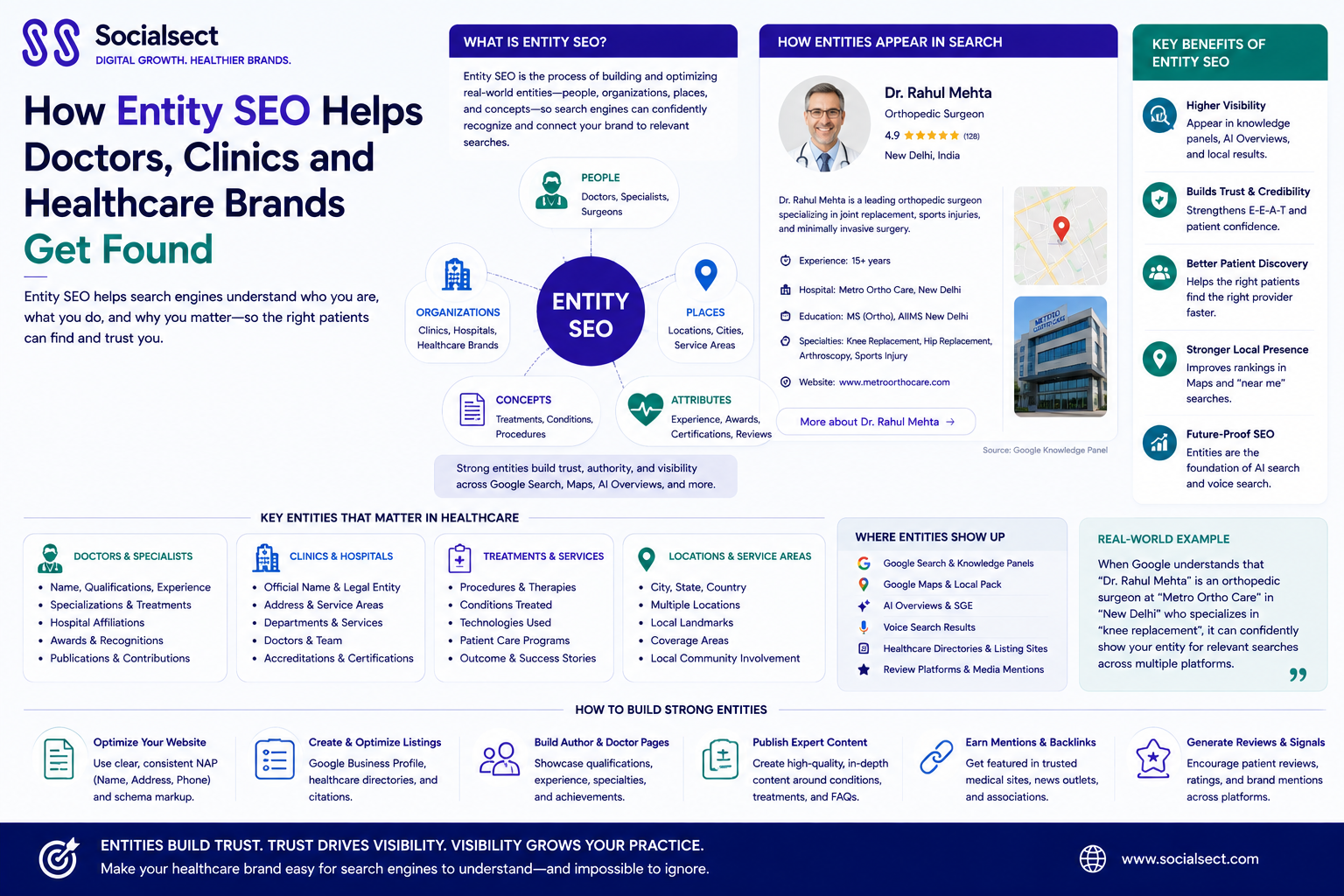
Search engines are becoming increasingly sophisticated at understanding who, what, where, and how different concepts are connected.
For healthcare organizations, this means ranking is no longer only about placing keywords on a webpage.
Google needs to understand that a doctor is a real medical professional, a clinic is a real healthcare organization, a treatment is connected to a particular specialty, and a location belongs to a specific practice.
This is where entity SEO healthcare becomes increasingly important.
Entity SEO helps search engines understand real-world entities and the relationships between them. Instead of treating a healthcare website as a collection of keywords and URLs, entity-focused SEO helps establish a consistent digital representation of the doctor, clinic, specialty, services, locations, and brand.
For doctors and healthcare organizations competing in crowded search results, this can strengthen topical relevance, brand understanding, local visibility, and overall search presence.
It can also help create a stronger foundation for visibility across traditional search and emerging AI-powered search experiences.
This guide explains what entity SEO means for healthcare, why it matters, how it works, and how doctors, clinics, and healthcare brands can build stronger entity signals.
What Is Entity SEO?
Entity SEO is the practice of helping search engines clearly identify and understand entities and their relationships.
An entity can be a:
- Person
- Organization
- Place
- Medical specialty
- Condition
- Treatment
- Procedure
- Healthcare service
- Brand
For example, consider:
Dr. Sarah Smith
She may be:
- A cardiologist
- Associated with ABC Cardiology
- Located in Miami
- Specializing in heart disease
- Providing cardiac testing
- Associated with particular medical organizations
Search engines can use information across the web to develop an understanding of these relationships.
The objective of entity SEO is to make those relationships clearer and more consistent.
What Does Entity SEO Healthcare Mean?
Entity SEO healthcare applies entity-based search optimization specifically to doctors, clinics, hospitals, medical practices, healthcare groups, and healthcare brands.
Instead of optimizing only for:
"cardiologist Miami"
a healthcare entity strategy considers the broader relationship:
Doctor → Cardiologist → Cardiology Practice → Miami → Cardiac Services → Heart Conditions
This creates a more comprehensive understanding of the organization and its expertise.
Why Entity SEO Matters for Healthcare
Healthcare search is highly competitive.
Patients may encounter:
- Hospitals
- Individual doctors
- Medical groups
- Health directories
- Review websites
- Healthcare publishers
- Competitor clinics
- Local listings
Simply targeting keywords may not be enough to establish strong visibility.
Healthcare entities need to demonstrate:
Who you are → What you do → Where you operate → What you specialize in → Who provides the service
A strong entity strategy helps connect these pieces.
Entity SEO vs Traditional Keyword SEO
Traditional SEO often starts with keywords.
For example:
"orthopedic surgeon in New York"
The strategy may include:
- Keyword research
- Title optimization
- Headings
- Content
- Internal links
- Local SEO
Entity SEO goes further.
It asks:
- Who is the orthopedic surgeon?
- What credentials does the surgeon have?
- Which clinic is the surgeon associated with?
- What services does the clinic provide?
- Which conditions does the surgeon treat?
- Where is the clinic located?
- Are these details consistent across the web?
The two approaches should work together.
Keywords help identify search demand.
Entities help search engines understand the real-world subject behind that demand.
The Most Important Healthcare Entities
A healthcare website can contain several connected entity types.
Doctor Entity
Examples include:
- Physician
- Surgeon
- Specialist
- Dentist
- Physiotherapist
Organization Entity
Examples include:
- Medical practice
- Hospital
- Clinic
- Healthcare group
- Health system
Service Entity
Examples include:
- Knee replacement
- Cataract surgery
- IVF
- Dental implants
- Physical therapy
Condition Entity
Examples include:
- Arthritis
- Diabetes
- Migraine
- Varicose veins
- Back pain
Location Entity
Examples include:
- City
- State
- Neighborhood
- Clinic location
A strong healthcare SEO strategy connects these entities naturally.
Build a Strong Doctor Entity
For individual physicians, entity SEO should begin with a comprehensive and accurate physician profile.
A physician page should clearly communicate:
- Full name
- Specialty
- Medical credentials
- Education
- Certifications
- Professional experience
- Clinical interests
- Practice affiliation
- Locations
- Services
- Professional memberships
Where appropriate, include links to relevant professional profiles and authoritative organizations.
The information should remain consistent.
If one website says a physician specializes in cardiology while another says neurology, inconsistent information can create confusion.
Optimize the Healthcare Organization Entity
The clinic or healthcare organization should also have a clear identity.
Important information can include:
- Official organization name
- Website
- Locations
- Phone number
- Services
- Specialties
- Physicians
- Business information
- About page
- Contact information
The organization should be represented consistently across its website and legitimate third-party profiles.
Create Connections Between Entities
Entity SEO becomes more powerful when related entities are connected.
For example:
ABC Orthopedic Clinic
↓
Dr. James Smith
↓
Orthopedic Surgeon
↓
Knee Replacement
↓
Knee Arthritis
↓
New York Location
This structure helps users navigate the website and provides search engines with clearer contextual relationships.
Internal linking plays an important role here.
Use Structured Data Correctly
Structured data can help communicate information about entities in a machine-readable format.
Depending on the organization and page, relevant structured data may include:
- Organization
- LocalBusiness
- MedicalClinic
- Physician
- Article
- BreadcrumbList
Structured data should accurately reflect information visible on the page.
It should not be used to make unsupported claims or manipulate search results.
For healthcare websites, accuracy is particularly important.
Strengthen the About Page
Many healthcare websites underestimate the value of the About page.
An effective About page can help establish:
- Who the organization is
- When it was established
- Areas of expertise
- Physicians
- Locations
- Services
- Professional affiliations
- Organizational experience
For larger healthcare groups, the About section can also explain the relationship between brands, locations, practices, and specialties.
Build Individual Service Entities
Don't treat services as simple keyword targets.
A major medical service should have a clear page explaining:
- What the treatment is
- Who may need it
- How it works
- What patients can expect
- Potential considerations
- Relevant specialists
- Available locations
- Related conditions
For example:
Dental Implant
can connect to:
Implant Dentist → Dental Clinic → Cosmetic Dentistry → Tooth Loss → Dental Implant Consultation
This creates a logical topical ecosystem.
Build Condition-Based Relationships
Healthcare content can also establish connections between conditions, symptoms, treatments, and specialists.
For example:
Back Pain
↓
Herniated Disc
↓
Spine Specialist
↓
Physical Therapy
↓
Spine Surgery
This does not mean every page needs to link to every other page.
Links should be relevant and useful to patients.
Local Entity SEO for Healthcare
Location is an important component of healthcare search.
A medical organization may be associated with:
- City
- State
- Neighborhood
- Multiple offices
- Service areas
For example:
Miami Shoulder Institute
can be associated with:
- Miami
- Shoulder specialist
- Orthopedic care
- Rotator cuff treatment
- Shoulder surgery
Local entity signals should be consistent across:
- Website
- Google Business Profile
- Legitimate directories
- Professional profiles
- Local references
Entity SEO and Google Business Profile
Google Business Profile is particularly important for local healthcare entities.
Ensure that the profile contains accurate:
- Business name
- Category
- Address
- Phone
- Website
- Hours
- Services
The profile should correspond to the real-world organization.
Do not create fake locations simply to increase local visibility.
Build Consistent Healthcare Brand Signals
Brand consistency matters for entity understanding.
Check whether your organization is represented consistently across:
- Website
- Social profiles
- Business listings
- Healthcare directories
- Professional associations
- News coverage
- Publications
Pay attention to:
- Name
- Address
- Phone
- Website
- Physician names
- Specialties
Inconsistent information can make the digital identity less clear.
Earn Relevant Mentions and Links
Entity SEO is not limited to your own website.
Third-party references can help establish relationships and credibility.
Potential sources may include:
- Medical associations
- Professional organizations
- Local organizations
- Healthcare publications
- Reputable directories
- University profiles
- Conference websites
- Industry publications
The emphasis should be on relevance and legitimacy, not simply acquiring large numbers of links.
Entity SEO and Healthcare EEAT
Entity SEO and EEAT can complement each other.
A strong healthcare entity should be supported by evidence of genuine expertise.
For a physician, this may include:
- Qualifications
- Clinical experience
- Professional memberships
- Publications
- Speaking engagements
- Professional profiles
For a healthcare organization:
- Established history
- Qualified clinicians
- Recognized services
- Professional affiliations
- Transparent organizational information
Do not manufacture credentials, awards, publications, or professional relationships.
Trust must be based on real information.
Entity SEO and AI Search
Search behavior is changing as AI-powered search becomes more prominent.
Users increasingly ask complex questions instead of typing short keywords.
For example:
"Which orthopedic specialists in Miami treat rotator cuff injuries?"
To answer this type of query, search systems need to understand relationships between:
- Physicians
- Specialties
- Treatments
- Conditions
- Locations
- Organizations
This makes clear entity representation increasingly valuable.
A website with strong structured information, authoritative content, consistent branding, and clear relationships can provide better machine-readable context.
However, no SEO technique can guarantee inclusion in an AI-generated answer.
The goal should be to make information accurate, authoritative, accessible, and easy to understand.
Entity SEO for Multi-Location Healthcare Groups
Entity SEO becomes especially important when a healthcare organization has multiple locations.
For example:
Healthcare Group
→ Location A
→ Location B
→ Location C
→ Location D
Each location may have:
- Physicians
- Services
- Departments
- Address
- Phone
- Opening hours
Each location should have a genuine purpose and unique information.
Avoid creating mass-produced location pages with minimal differences.
Common Entity SEO Mistakes
Inconsistent Business Information
Different names, addresses, or phone numbers can create confusion.
Weak Physician Profiles
Minimal doctor bios provide limited context.
No Relationship Between Pages
Disconnected services, doctors, conditions, and locations weaken the site's information architecture.
Incorrect Structured Data
Structured data should never contain misleading information.
Fake Entities
Creating fake doctors, offices, organizations, or locations can damage trust.
Keyword-Only Optimization
Repeating keywords does not establish a genuine healthcare entity.
Ignoring Off-Site Information
Search engines can encounter your brand across many sources.
Entity SEO Healthcare Checklist
Use this checklist to strengthen your healthcare entity presence:
Organization
- Official organization name is consistent
- About page is comprehensive
- Contact information is accurate
- Locations are clearly documented
- Services are clearly defined
Physicians
- Physician profiles are complete
- Credentials are accurate
- Specialties are clear
- Practice affiliations are documented
- Professional profiles are consistent
Services
- Major services have dedicated pages
- Treatment information is useful
- Services connect to relevant physicians
- Services connect to relevant conditions
Local SEO
- Google Business Profile is accurate
- Location pages are useful
- Business information is consistent
- Local references are legitimate
Technical SEO
- Structured data is implemented appropriately
- XML sitemap is maintained
- Canonical URLs are correct
- Internal links connect related entities
- Important pages are indexable
Authority
- Professional profiles are accurate
- Relevant third-party mentions exist
- Healthcare credentials are visible
- Content demonstrates expertise
How to Measure Entity SEO Progress
Entity SEO is not always represented by one simple metric.
Instead, monitor multiple indicators.
Brand Searches
Are more users searching for the practice or physician by name?
Knowledge and Search Features
How does the organization appear when users search for the brand or physician?
Branded Visibility
Are accurate business and physician details appearing across search results?
Local Visibility
Are relevant locations appearing for appropriate local searches?
Organic Traffic
Are important service, condition, physician, and location pages attracting qualified visitors?
Patient Actions
Are users calling, booking, submitting forms, or requesting consultations?
The objective is not simply to "rank an entity."
The objective is to build a strong and trustworthy digital presence around the real-world entity.
How Socialsect Can Help With Healthcare Entity SEO
At Socialsect, entity SEO can be integrated into a broader healthcare SEO strategy.
Our approach can include:
- Healthcare entity mapping
- Physician entity optimization
- Organization optimization
- Service and condition architecture
- Local SEO
- Internal linking
- Structured data
- Healthcare content strategy
- EEAT optimization
- Brand consistency
- Multi-location SEO
- AI search optimization
- Technical SEO
The focus is on creating a connected digital ecosystem where search engines and patients can clearly understand:
Who you are. What you do. Where you operate. What you specialize in. And why your organization can be trusted.
Final Thoughts
Entity SEO healthcare is about helping search engines understand real healthcare organizations rather than simply matching keywords on individual pages.
For doctors, this means establishing clear connections between their identity, credentials, specialty, services, practice, and locations.
For clinics, it means building a consistent organization entity connected to physicians, treatments, conditions, and locations.
For larger healthcare brands, it means creating a scalable architecture connecting providers, specialties, departments, services, locations, and the overall organization.
The strongest strategy combines entity SEO with technical SEO, high-quality healthcare content, local SEO, EEAT, structured data, internal linking, and genuine authority.
As search becomes increasingly contextual and AI-powered, healthcare brands should focus less on simply inserting keywords and more on building a clear, accurate, trustworthy digital identity.
That is the foundation of effective healthcare entity SEO.